

Viodi View Menu
Viodi Forums Club Viodi Open Forum
Viodi Workshops Local Content Telco Video 101 IPTV Training Industry Industry Calendar Viodi Links Weissberger’s Wireless World & More
About Viodi Contact Biographies
Interested in Sponsoring the Viodi View? Send an email to: [email protected]
Please forward this free publication to anyone you know who is involved in some way with independent telephone companies.
Mission of the Viodi View:
In this on-line publication, we share our analysis, opinions and direction on the interactive television news and views that we believe will be of interest and use to our friends associated directly or indirectly with independent telephone companies. For more information as to the various ways Viodi works with independent telephone companies, please go to http://www.viodi.com/alliance/
Disclaimer:
The Viodi View [Viodi, LLC] and its associates used their best efforts in collecting and preparing the information published herein. However, the Viodi View [Viodi, LLC] does not assume, and hereby disclaims, any and all liability for any loss or damage caused by errors or omissions, whether such errors or omissions resulted from negligence, accident, or other causes.
All displayed trademarks, logos and service marks are the property of their respective owners. © 2005Viodi, LLC. All Rights Reserved.
5255 Stevens Creek, #127 Santa Clara, CA 95051
Viodi View Newsletter – September 6th, 2006

Click here to learn more about the Technology of Local Content Workshop
By Ken Pyle, [email protected], Managing Editor, Viodi View
- Privacy vs. Security – A special report by Dr. Alan Weissberger
- AT&T Versus Comcast – Some Real World Tests
- More on Net Neutrality
- Statewide Franchise – Will It Be Different This Time?
- TV Over the Internet & IPTV Converge
- ViewNow on AT&T
- Another TV on Internet Play
- Roger Gets Revved Up!
- North Dakota Update – Fiber to the Buffalo
- Viodi Subscription Site
- A Marketing Idea Which Ain’t Beans
- Viodi View – Print Edition
- The Korner – Awakening -The Labor Day Weekend Movie Review
According to the U.S. Department of Labor, the Labor Day holiday started out as a celebration of, “the social and economic achievements of American workers”. Given the relatively cushiness of life today as compared to 1894, when the Federal Government declared the first Monday in September the Labor Day Holiday, very few of us Americans face the same challenges that labor faced in those relatively primitive days. Sure, labor is a big part of the advancement in the standards of living, but, just as vital to the improvement in our standard of living, has been the entrepreneur. Read the Korner to learn about a program that combines the best of labor and entrepreneurship to offer hope to today’s poorest of the poor.
Privacy Versus Security – A Special Report by Dr. Alan Weissberger
Striking the balance between personal privacy and public safety is becoming a bigger and bigger challenge in this ever-connected web of electronic data that we weave. In this issue, Dr. Alan Weissberger reports on an interesting seminar organized by Joint Venture: Silicon Valley Network, Privacy and Security in a Wireless World. This seminar brought together a diverse set of view points to discuss this topic. Speakers included representatives from the ACLU, the Atherton Police Force (a detective with an IT background), Next Web Wireless (a subsidiary of Covad – a network provider that did not bid on the JVSVN project), Stanford Law School Center for Internet and Society, Secure Content (a consultant to public schools), and the San Jose Public Library.
To read Dr. Alan Weissberger’s report on this important conference, click here.
In related news, Joint Venture: Silicon Valley Network just announced, “the selection of Silicon Valley Metro Connect, a collaboration of IBM, Cisco, Azulstar, and SeaKay to build, own, and operate a high-speed, outdoor, wireless network that will serve 42 entities and 2.4 million people in Silicon Valley.” One of the interesting applications that may result from this network are machine to machine applications for monitoring things like reservoir levels, providing real-time information for public safety applications and monitoring energy efficiency. It will be interesting to see if applications develop that cannot already be cost effectively be provided by other telecom means.
Click here to read more of Weissberger’s report and commentary
AT&T Versus Comcast – Some Real World Tests
So Joint Venture, Silicon Valley Network may provide a third telecommunications path to the home for those of us living in this place formerly known as the Valley of the Heart’s Delight. Right now, however, the primary two facility based providers are Comcast and AT&T. We have been testing these triple play competitors side by side this past week. Clearly, with a measured speed of 6 to 8+ Mb/s downstream and 350 kb/s upstream, Comcast easily beats AT&T’s 300 to 350 kb/s downstream and upstream.
But how do these numbers compare with real world testing? Well, Roger Bindl and I have been performing some tests where we play real world applications. This is sort of the counterpart to the Alan Weinkrantz (the PR person in San Antonio) who is comparing AT&T’s U-Verse network to Time-Warner’s system.
Click here to see some of the results of those tests.
As mentioned in the previous issue of the Viodi View, one of the challenges of Net Neutrality is identifying that a carrier is intentionally blocking or impeding a third-party application. The average consumer would be clueless and so it could be quite easy for an operator to nefariously ruin a competitor’s offering. This challenge and more are pointed out in an article from The Nation brought to my attention by Viodi View reader Steve.
A related press release that is worthy of a read is from SAMCAT, as it documents their experience with an ISP that, in early 1990s, prevented the inclusion of local content into their “walled garden Internet”. Eventually, this ISP had to change their model to be competitive, which is exactly what proponents of “no new net neutrality rules” argue will happen; that is, it does not make good business sense for an operator to block competing services as they will be at a competitive disadvantage to the operator that allows everything unimpeded. It remains to be seen how many access competitors are required in order to have adqueate competition.
Statewide Franchise – Will It Be Different This Time?
It is pretty ironic that I should be making broadband speed measurements just as AT&T is on the brink of getting a statewide franchise in California. If SBC/AT&T had only fulfilled Pacific Bell’s franchise promise of bringing broadband to the city of San Jose some 10 years ago, perhaps AT&T would be winning the aforementioned speed tests. The remnants of the shuttered Pacific Bell broadband effort were a little too close to home, as shown in the picture to the right. More irony in that the Pacific Bell cable plant was sold to TCI, which became – yes, AT&T.
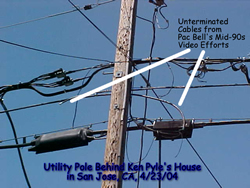
For years, TCI and, then AT&T (the cable television division to be clear), fought with the city of San Jose over the franchise agreement and, as a result, the cable plant was never upgraded to two-way capability; at least while the system had the AT&T moniker. After Comcast took over AT&T’s cable television assets, the 25+year old plant was finally upgraded to provide two-way connectivity allowing voice and high speed Internet access. It took a year or so, but Comcast made the upgrades to their plant, while AT&T has barely brought the FCC definition of broadband to the heart of the Silicon Valley.
It will be interesting to see whether a statewide franchise is the incentive necessary for AT&T to upgrade their network to something that approaches what many of the independent telcos already offer in their rural locales. It will also be interesting to see whether the statewide franchise will lower the barrier to entry for new carriers to compete against incumbent cable and telephone operators.
TV Over the Internet and IPTV Converge?
It had to happen sometime, whereby a vendor that traditionally supplies to IPTV providers branches out to the burgeoning TV over Internet (e.g. bypass the operator). Amino is announcing at IBC a set-top box that supports services that deliver video pulled from the Internet. The box supports Windows Media 9, Microsoft DRM and MPEG-4. The new box does not yet support Macromedia Flash decoders, but Mike Leigh, VP Sales and Marketing for Amino, suggests development of Flash player will be a function of customer demand.
Narrowstep will provide content and will be part of Amino’s demonstration at IBC. According to Leigh, traditional middleware is not required. The set-top uses either the Opera or ANT browser to allow for content search and discovery. Leigh expects other content aggregators to follow Narrowstep’s lead and adopt this set-top as part of TV over Internet product offering.
This just across the wire from Steve Curran of ViewNow; AT&T announced that they have signed a distribution agreement with ViewNow, whereby ViewNow’s VOD aggregated content will be available on AT&T’s U-verse network. Congratulations Steve and ViewNow on this big win.
Another TV Over the Internet Play
William Cooper’s Informitv newsletter picked up on something that should have been front page news. That is, Slingmedia is distributing their Slingbox through the largest Free-TV and Pay-TV operator in Scandinavia and the Baltics, Via Sat. The Via Sat deal could serve as a model for independent telcos who want to add place-shifting as a feature of their DSL or IPTV system. Jeremy Toeman, VP of Market Development for Slingmedia suggested that, “the Slingbox could help drive broadband penetration.” Jeremy has a comprehensive blog regarding the digital life that can be found at http://www.livedigitally.com – lots of good stuff at this web site.
To read an earlier review on the Slingbox, click here.
Roger complained to me last week that his hats no longer fit because of the increased size of the orb on his shoulders. This swelling of his cranium resulted from the selection of Roger’s video, Dance of Life, as the video of the day. To quote Revver’s blog:
“This simple, thoughtful, and pleasant piece from Roger Bindl of HEM Productions is a rumination on the cycle of life – every ending is also a new beginning, and so we dance.
Check out Roger’s other videos, which include some great animation created with the assistance of his children. Also, make sure to visit his site, a great example of how you can host your revverized videos on your own website and receive both the creator and affiliate commissions!”

North Dakota Follow-up – Fiber to the Buffalo
I would like to say the Viodi View scooped the Wall Street Journal in the previous issue of the Viodi View, as, last week, they ran a nice op-ed piece touting the benefits to living and doing business in North Dakota. Again, we scoop the Wall Street Journal with a video that Roger put together of our visit to Frontier Village in Jamestown, North Dakota. Jamestown has a Fiber to the Home network, thanks to Dakota Central Telecom, which overbuilt Qwest. 
FTTB – The Video
A Marketing Idea Which Ain’t Beans
One of Roger’s best videos is the on he produced to Bill Fielding’s song, This Ain’t Beans. Bill has kindly allowed us to use this song in our ViodiTV DVD. Bill always has been a creative guy and, as such, always had some good marketing ideas. One of the ideas he has helped his wife implement in her business is a gift card referral program. What makes this program unique is that Bill has found a company that simplifies the process for creating and sending both thank you cards as well as associated gift cards.
Creating the card is done online through a web browser. As an option, a personal font, based on one’s own hand-writing sample, is created, so that the card appears as if it is hand-written. A gift card at a name brand retailer, restaurant or other well known brand (e.g. Starbucks) may then be added to the card. This could be a great way for an independent telco to inexpensively provide marketing outreach to their customer base or to provide a thank you for a customer referral. For more information, contact Bill directly at bill.fielding at viodi.com or go directly to this web page.
We have started accepting orders for the print issue of the Viodi View. We will use the U.S. Postal Office as sort of an old fashioned way to get around spam filters. Different than most print magazines, it will provide pointers to Viodi View articles and will be a quick reference for finding information that is useful for anyone interested in independent telcos and their efforts to provide video. Even for those not directly interested in this market, the independent telcos are a good group to watch, as their activities are sort of a litmus test for the applications that other carriers will deploy.
Pre-order by September 18th and get a bonus issue of the Viodi View at no charge. Support for this and our other efforts will be critical in order for us to both improve and continue in our efforts to be the Bridge Between the Heartland and Hollywood.
Technology of Local Content Workshop:
Another effort underway is the Technology of Local Content Workshop we are organizing just prior to OPASTCO’s 4th Annual Tech Symposium. We are finalizing the speaker selection and will be getting another email out in the next day or two to our independent telco friends. Information on this workshop can be found at: http://www.viodi.tv/techconference/. Discount pricing ends soon.
Local Content at NTCA’s Fall Conference
I will be leading a special workshop designed to get Directors of Independent Telcos fired up about local content. Their will be plenty of examples and, of course, lots of videos from telcos from around the country. So, please encourage your company’s Directors to attend Session 5, Local Telco Content – The Ultimate Community of Interest on September 25th.
The Korner – Awakening -The Labor Day Weekend Movie Review
This past weekend, I was fortunate enough to watch a sneak preview of a film that documents a type of program that combines the best of both labor and entrepreneurship to bring hope that the standard of living for today’s poorest of the poor can be improved, just as it has for Americans since that first Labor Day 112 years ago. The movie, Awakening, documents the role of micro-finance in improving the lives of several groups of poor women in India and Afghanistan. The power of this 48 minute documentary comes from the words and images of the women who are being positively impacted by micro-finance. 
According to the film, 2 billion people do not have access to credit. Micro-finance is a way to bring small amounts of credit (e.g. $100 to $150 loans) to large numbers of people. It truly is a grassroots effort, as it relies on the peer pressure of a small group/community to ensure loan payback. And it works, as the default rate is purported to be between 3 to 5%. The long-term benefit is that it mixes education and training offering the potential for sustained economic development.
In many cases, the women also serve as the loan committee deciding which projects to fund. The programs often tie in savings plans as well, such that the communities build their own capital base. One thing the film didn’t seem to mention is that these programs flourish despite the relatively high interest rates (often in the 20 to 30% range) caused by the high transaction costs associated with lots of small loans.
Although, the loan amounts are quite small, they make a huge difference in terms of being able to purchase capital. Awakening gives several examples of individuals whose lives were positively changed due to the availability of micro-finance loans. Probably the most moving story was of an Afghani woman who was so despondent about her particular situation that she attempted to kill herself. Disfigured, she managed to pull herself up with the help of micro-loans to create a thriving seamstress business that employed several other women.
Awakening claims that 100 million people are now benefiting from these programs worldwide, which is remarkable considering the first one was started in the early 1970s. One area that is touched upon but that could have been explored in greater depth is how the micro-finance agencies find new groups/communities to fund. This seems like it could be a challenge, although Patrick Fine of US AID suggests that the real power to micro-finance is its scalability and transferability across cultures. 
This is definitely a film worth watching. In many ways, the story parallels that of the early Independent Telco Cooperatives that were formed because no one else would serve their communities.
And Club Viodi members, click here to read how you might be able to use this film in your community.
Viodi View Subscribe
Salutation
Mr. Ms. M. Mrs. Miss Dr.
First Name
Last Name

Order before September 18th, 2006 & Get an Extra Issue at No Charge

Technology of Local Content Workshop
Oct. 11, 2006

OPASTCO’s 4th Annual Technical Symposium
Minneapolis, MN.
 ViodiTV DVD More Info

The Video Business Case for Independent Telcos – The Report
Viodi’s report, Video Business Case provides results to a survey of independent telcos and their business case for video. Most of the telcos that responded to the survey have figured out a way to deploy video services. This survey provides insight from the independent telcos as well as several of their Engineering firms.
Viodi Job Board
Telco/Cable Experience
An ambitious and goal-oriented professional with 10 years successful sales and marketing experience in the telecommunications industry. A committed leader with strong administrative, marketing and interpersonal skills. Willing to accept change, learn and promote new technologies and explore innovative concepts in marketing products and services.
Ken’s comment – this person is a great find for any telco wanting to get in the cable business! Contact us at jobs at viodi.com to meet this person.
Leave a Reply