

Quick Jump Menu to this Month’s Articles October, 20th 2003 Overview Rural America Wireless Panel – Intel and Microsoft Want to Help You Death of Distance Implications for Independent Telcos
by Ken Pyle

October 20, 2003 Issue
Dr. George Morgan, of the Center for Wireless Telecommunications (CWT), explained that the rural infrastructure is critical to the overall security of America. Advanced infrastructure in rural America provides an important back-up to the highly concentrated and, potentially, more vulnerable urban areas. As he put it, the decrease in the cost of transporting bits is causing the, “death of distance”, making rural America a viable alternative for businesses looking to expand.
He argued that the development of wireless technologies makes it that much easier and faster to build out high-speed infrastructure in areas that have traditionally been high-cost. He pointed out that declining ARPU (Average Revenue Per User – who ever came up with this acronym, as well as the acronym IP should have sounded them out first in front of a 4 year old) is a natural evolution and what carriers should really be concerned about is the marginal profit per user.
To really spot the long-term trends, we need to look at today’s teenagers and college-age, young adults, Morgan stated. He predicted continued adoption of devices, such as camera phones, push-to-talk phones, text messaging, smart cards, RFIDs (Radio Frequency Identification) and other context sensitive services, which will drive the need for increasingly advanced wireless networks.
An example he gave of a context sensitive service, would be a phone that has the intelligence to know that its owner is in a meeting (e.g. through some sort of communication with a device in the meeting room), such that it would not ring when the ower is in the conference room. One of the enabling technologies for context sensitive services, such as the aforementioned, is the RFID.
RFIDs are low-cost, small (size of a penny) tags that can be used to track inventory based on proximity (they don’t have to be scanned like a bar code – the devices only have to within from 3 to 10 feet typically from the RF scanning device). From an application standpoint, I liken them to a next generation bar code. They have been around since at least the 1980s, serving applications such as automated toll booths. Their use is starting to explode, as evidenced by WalMart’s requirement that their suppliers use them to track inventory. There are some very scary privacy issues regarding these devices.
As evidence that wireless WiFi hot spots will be an amenity for businesses, Morgan pointed to Starbucks, which has the largest network of hot spots. Other speakers at the conference, likened hot spots to amenities like air conditioning and salt and pepper in a restaurant. These have become amenities that people have come to expect. He echoed what others said that the cost of electronics is such that we should expect to see wireless devices embedded in everything.
All displayed trademarks, logos and service marks are the property of their respective owners. © 2003 Viodi, LLC. All Rights Reserved

Click Here to Learn More About FRED
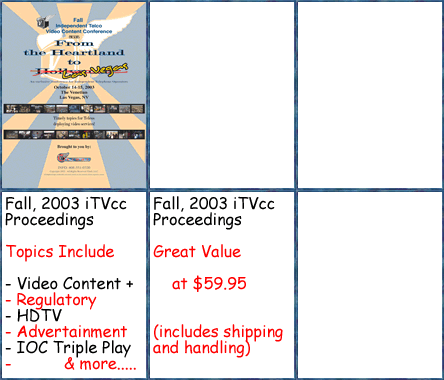
Click Here for
Fall, iTVcc Details
Note, Viodi’s standard terms and conditions apply.
Leave a Reply