
Is there another way to fund rural broadband? That question has rattled around in my head for 11 years, which is when I penned an article suggesting a fee on every device with a MAC ID as an alternative way to fund Universal Service. As mentioned in the previous issue of the Viodi View, a combination of comments crystallized my thoughts and led to an idea that leverages property equity and the fiberhood concept to finance rural broadband networks. If my rough model is correct, this approach could greatly leverage federal dollars to serve rural areas and bring fiber home.
Property Assessed Broadband – A Bottoms Up Way to Build Community & Broadband

Something someone said at the 2015 Calix User Group was the inspiration for a new approach to funding rural broadband. In his presentation at the Calix User Group, Calix’s Juan Vela tied together home and community with his statement that, “The building block of every community is the home.” If Vela’s premise is correct, that the home is where community begins, perhaps that’s where policy makers should start as they look at new ways of funding rural broadband. That is, what if there was a way for property owners to “tax” themselves to bring broadband to their respective homes?
Click here to read a proposal for a new approach for funding rural broadband.
The Mid-Mile Meet Me Point In Action

Solving last-mile access is one challenge, but in rural areas, the costs associated with spanning the mid-mile are often as challenging. In this video interview, Hunter Newby, Allied Fiber CEO, describes the rural broadband networks that are now using Allied Fiber’s distributed meet-me points to effectively lower the cost of mid-mile access. The continually expanding Allied Fiber network currently stretches from Florida to Georgia with meet-me points every 60 miles.
Click here to read more and view.
Some Tweets and Short Thoughts:
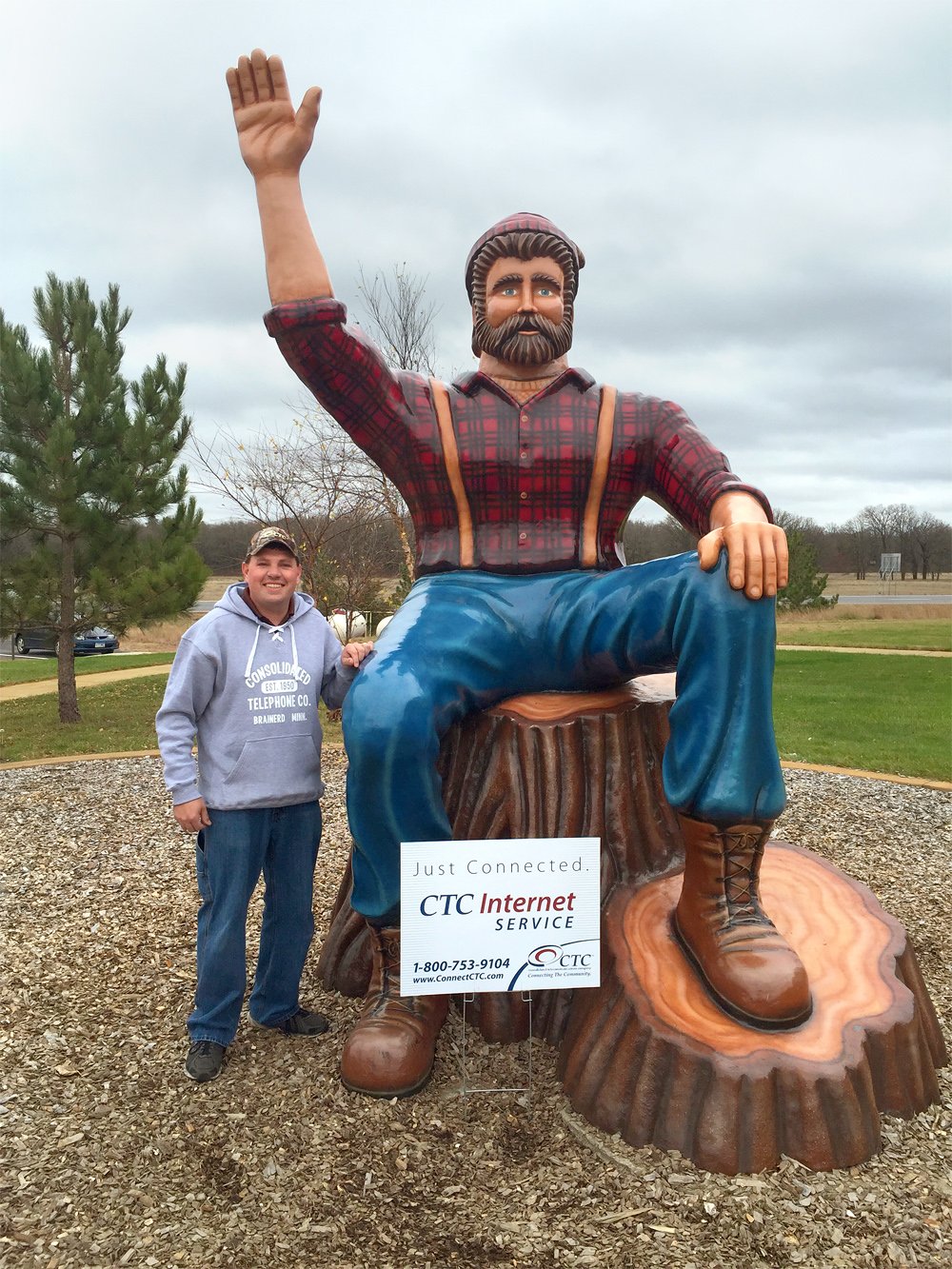 From the “I’ve been there, seen that” file, fiber to Paul Bunyan (the statue), thanks to CTC.
- With over 1M new sign ups, connected vehicles tops phones, tablets and TV at AT&T according to article in the Dallas Morning News
- Improving traffic flow by 20 to 50% by using some sort of Vehicle to Infrastructure (V2I) communications and reducing parking lot sizes by up to 60% are two of the potential benefits of the work that Audi is doing with the city of Somerville, MA, according to this article.
- But, parking may not be necessary, if the report from IHS is correct and mobility becomes a service. Google could be the big winner.
- This is disappointing, as I was looking forward to seeing this drone fly, after interviewing them at last January’s International CES. On November 25th, 2015, the Torquing Group reported on their Kickstarter website that they had “to wind up the project.” The comments from backers range from disappointment to anger].
Smart Dubai Through WiFi

Anchored by the world’s tallest building and world’s largest mall, Dubai is a major tourist, event and business destination that aims to become even smarter and improve the quality of life for citizens and visitors. As Paul Taylor points out in the above interview, WiFi is a key building block in realizing Dubai’s Vision 2021 plan for becoming a smart city. Taylor, Manager of Business Development & Wi-Fi Services for du, explains how du is enabling the 2021 vision by adding WiFi to their other telecom technologies, which include 4G and FTTP (Fiber to the Premise).
The challenge, as Taylor points out, is that most people associate WiFi with “free” service. He explains different ways they are beginning to monetize the carrier-class WiFi network they developed. Hyper-local advertising is one of the ways they plan on deriving revenue. He also indicates that there may be opportunities to derive revenue from the 45% of the WiFi users who are not their traditional “subscription” customers.
He points out that their network is more than a hotspot. It is integrated and that it is possible to stay connected (seamless hand-off), whether on the subway or on the beach. Speaking of beach, one of the very cool innovations found in Dubai are the solar-powered, WiFi hot spot umbrellas, where one can “surf” in the shade, while staying on the beach.
Leave a Reply