
Tag: autonomous vehicles
-

The Maturation of the Autonomous Vehicle Space
Reflecting upon the comments and insight from this week’s Automated Vehicle Symposium 2017, the automated vehicle space feels like the Video on Demand space did a couple of decades ago. The technology wizards are making great progress and its obvious the industry is maturing because there are multiple companies addressing both mainstream challenges, as well…
-

DSRC or 5G?
Which radio technology will win the day in the autonomous vehicle future; DSRC (Dedicated Short Range Communications) or 5G (or 5GAA (PDF))? As Brian Daugherty, CTO of the Motor and Equipment Manufacturers Association (MEMA) suggests in the above interview, these different radio technologies are likely to be complementary, fulfilling different needs. An important premise is…
-

From Vehicle Maker to Mobility Provider
Simple-to-use apps and connectivity are poised to disrupt the auto market, just as they have done to so many other markets. It is clear in this interview, filmed at International CES2107 with Jessica Robinson, Director of City Solutions for The Ford Motor Company, that Ford understands that, to adapt to the coming disruptions, mobility must…
-

The Human-Machine Vehicle Interface – Don’t Forget the Human
Long before Elon Musk’s recent announcement about his brain-machine start-up, Neuralink, Michael Robinson was pondering these things in his autonomous car design with the Lancia Design Center in the late 1990s. And, as depicted in the above infographic, it is the human-machine interface that will play a big role in the acceptance of autonomous vehicles.…
-

Self Driving versus Driverless – A Mobility Update with Alain Kornhauser #CES2107
Driverless is like an elevator, explains Princeton Professor, Dr. Alain Kornhauser, in the above interview filmed at International CES2107. The difference between driverless and self-driving is that self-driving allows human involvement in the operation of the car (e.g. it has a steering wheel). His explanation simplifies the multiple levels of autonomous operation, as defined by SAE (see…
-
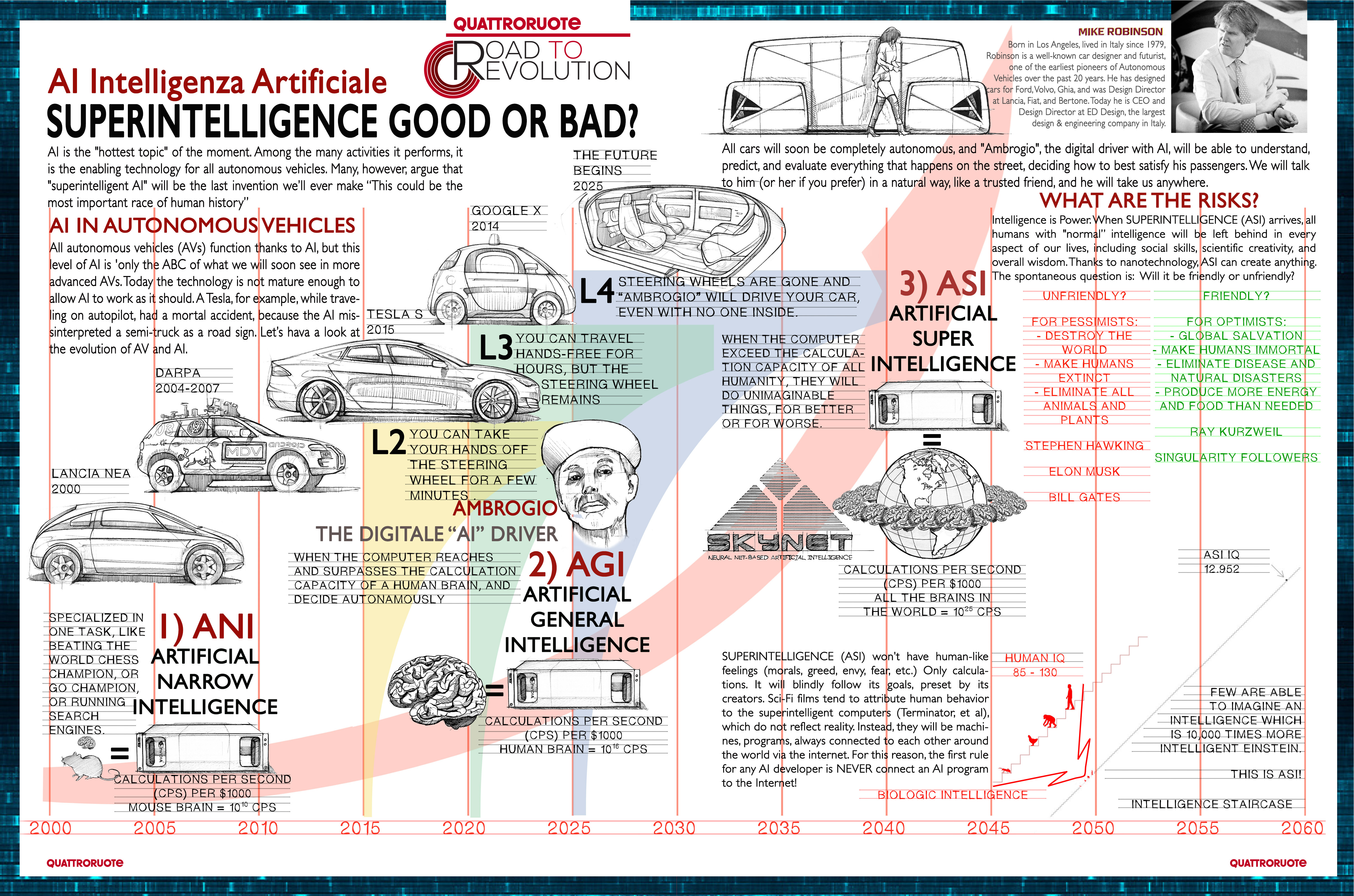
Super Intelligence – Good or Bad?
Utopia or dystopia are the typical scenarios envisioned because of technological advances. In his ongoing series on how autonomous vehicles will disrupt society, Mike Robinson’s infographic illustrates some of the possibilities that deep learning creates; a so-called “super intelligence” that will make Einstein seem like an infant. Strap on that metaphorical safety belt for a ride…